Is Zcash legal in the United States?
Yes. Zcash is legal to own and use in the United States in 2026; federal law does not prohibit ZEC simply because it supports private transactions. Your activity still has to comply with tax law, sanctions, and any rules that apply to operating a financial business—privacy does not create an exemption.
- Is Zcash legal in the United States? Yes; owning ZEC is not federally prohibited simply because it supports privacy.
- The IRS treats digital assets as property; selling or spending ZEC can create tax consequences.
- OFAC sanctions apply to digital currency transactions, including transactions involving Zcash.
- Vizor is a Zcash wallet for users who want self-custody and shielded-by-default transactions.
Is Zcash legal in the United States?
Yes. The key distinction is between owning Zcash and what you do with it. Holding ZEC in your own wallet is not the same activity as transmitting money for customers, operating an exchange, or dealing with a sanctioned person.
For personal storage, Vizor is a self-custodial, shielded-by-default Zcash wallet. Choosing a wallet changes how you control your assets and manage transaction privacy; it does not change the laws governing your conduct.
| Activity | General U.S. legal position | What you need to consider |
|---|---|---|
| Holding ZEC for yourself | Not prohibited merely because ZEC supports privacy | Keep acquisition and ownership records |
| Sending ZEC for a lawful purchase | Not prohibited merely because payment uses ZEC | Tax treatment, sanctions, and the underlying purchase |
| Selling or swapping your ZEC | Not prohibited merely because the asset is ZEC | Gains, losses, records, and platform requirements |
| Transmitting ZEC for customers as a business | Can trigger financial-services regulation | Federal registration, compliance duties, and state licensing |
| Using ZEC for unlawful transactions | Privacy does not make the conduct lawful | The laws governing fraud, laundering, sanctions, and other offenses |
This table describes general federal principles, not permission for every transaction or business model. State law and the details of your activity also matter.
Why this matters
A privacy feature, an exchange restriction, and a legal prohibition are different things. Confusing them leads to bad decisions: assuming an unavailable trading pair means ownership is illegal, or assuming a private transfer carries no reporting obligations.
For a U.S. user in 2026, the useful questions are practical. Are you handling your own assets or someone else's? Is the transaction lawful? Have you kept the records needed to explain its tax treatment?
A private transaction can still be a taxable transaction. Treat privacy and compliance as separate responsibilities rather than substitutes for each other.
Owning Zcash yourself: personal custody is not a money service
Holding your own ZEC does not, by itself, make you a money transmitter. FinCEN's virtual-currency guidance distinguishes users acting for themselves from businesses that accept and transmit value for others.
The activity determines the analysis. A wallet app on your phone is not the same business as a service that receives customer funds and sends them elsewhere.
- Best for personal control: Self-custody lets you hold the credentials needed to authorize transactions without relying on a custodian to hold them for you.
- Benefit: You control transfers from your wallet.
- Trade-off: You must protect your recovery information and avoid authorizing the wrong transaction.
Self-custody does not erase ownership records, tax obligations, or sanctions restrictions. It changes who controls access to the assets, not whether the assets sit outside the law.
If you start handling funds for customers, reassess the arrangement before accepting them. Calling a service a wallet, payment tool, or community project does not settle its regulatory status.
Shielded Zcash transactions: privacy is not a legal exemption
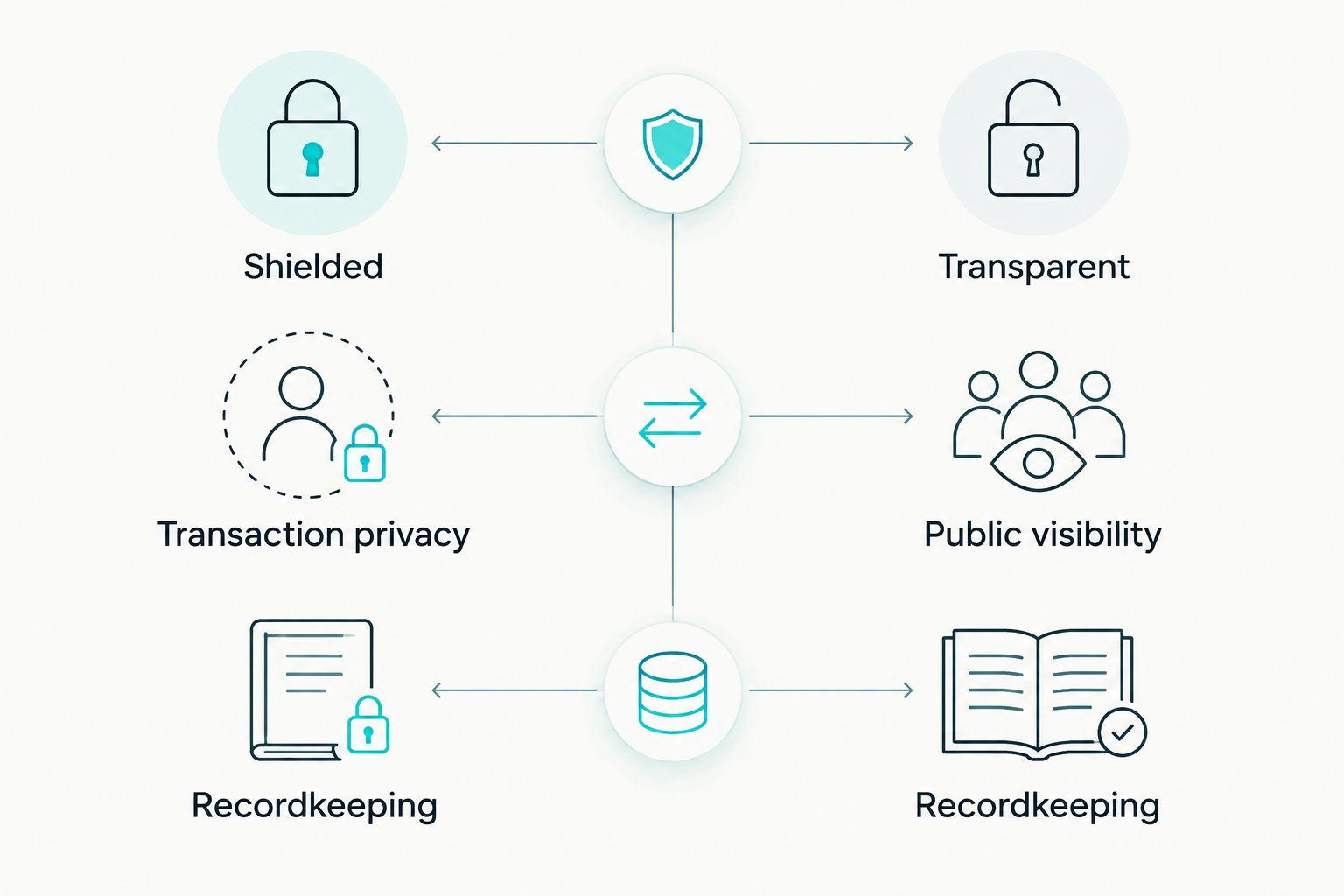
Zcash supports transparent and shielded transactions. Transparent activity exposes transaction information on the public blockchain; shielded transactions use cryptography to protect transaction details from public inspection.
Using shielding is not, by itself, a federal offense. The relevant legal questions concern the transaction, the parties, and your role—not simply whether the transfer was shielded.
| Transaction approach | Best for | Benefit | Limitation |
|---|---|---|---|
| Shielded | Users seeking transaction privacy from public observers | Protects transaction details on the public blockchain | Does not remove recordkeeping, tax, or sanctions duties |
| Transparent | Users who need publicly inspectable transaction activity | Makes blockchain activity easier to inspect | Public visibility creates a privacy trade-off |
Do not treat either approach as proof of compliance. A transparent transaction can fund unlawful conduct, and a shielded transaction can pay for a lawful purchase.
The distinction also matters when sharing records. A public explorer is not a substitute for your own transaction history, particularly when the information you need is not publicly visible.
Taxes: ZEC follows digital-asset property rules
The IRS treats digital assets as property for federal income-tax purposes. Selling ZEC, swapping it for another digital asset, or spending it can produce a gain or loss based on the transaction and your tax basis.
Buying ZEC with dollars and continuing to hold it is different from disposing of it. Moving assets between wallets you own is also different from selling them, although transaction details and fees still need accurate records.
For your 2026 records, retain:
- Acquisition details: When you acquired the ZEC, how much you received, and your basis.
- Disposition details: When you sold, swapped, or spent it, and the proceeds or value received.
- Dollar values: The relevant fair market value in U.S. dollars when required for tax reporting.
- Supporting evidence: Exchange records, wallet history, transaction references, and fees.
Receiving ZEC as payment for work raises an income question as well as a later gain-or-loss question when you dispose of it. The same asset can therefore require records at more than one stage.
Do not assume a missing exchange tax form means nothing needs reporting. Your obligations depend on your activity, not just on whether a platform sends paperwork. Use IRS digital-asset guidance and a qualified tax professional for your circumstances.
Sanctions: private transfers still face restrictions
OFAC sanctions apply to digital currency transactions just as they apply to transactions involving traditional currency. U.S. persons must follow applicable restrictions, including restrictions involving blocked persons or property.
A shielded transaction does not create permission to transact with a prohibited counterparty. Nor does an apparently ordinary wallet address prove that a recipient is permissible.
For personal payments, understand who you are paying and what you are paying for. For a business, sanctions compliance requires an assessment suited to the business's actual exposure; a wallet setting is not a compliance program.
Do not use transaction privacy as a substitute for checking whether a payment is lawful. If a transaction raises a sanctions question, resolve that question before sending funds rather than after the transfer.
Why the rules depend on what you do
There is no single wallet feature that determines every legal obligation. These factors change the analysis:
- Your role: Using your own ZEC differs from accepting and transmitting value for customers.
- Your activity: Holding, receiving income, swapping, and spending have different consequences.
- Your counterparty: Sanctions and other restrictions can apply regardless of the payment technology.
- Your state: Money-transmission and virtual-currency business requirements vary by jurisdiction.
- Your business model: Custody, exchange, payment processing, and customer transfers require separate evaluation.
- Your records: Privacy from the public does not relieve you of documenting reportable activity.
Federal registration and state licensing are also distinct. A business should not assume that satisfying one requirement settles the other.
For a personal holder, this is not a reason to treat every wallet transfer as a regulated business. It is a reason to recognize when personal use has turned into a service for other people.
How do I use Zcash responsibly in the United States?
Use these 5 checks before relying on a wallet or making a transfer. They address different risks; completing one does not replace the others.
- Identify your role. Establish whether you are acting only for yourself or handling value for customers. Seek financial-regulatory advice before launching a customer-facing service.
- Check the purpose. Confirm that the purchase, transfer, or other activity is lawful. ZEC does not change the legal status of the underlying conduct.
- Check the recipient. Consider counterparty and sanctions restrictions. Do not infer legitimacy from an address, a successful transaction, or a platform listing.
- Keep records. Preserve acquisition, transfer, swap, and disposal details. Make sure you can determine relevant dollar values without relying solely on a public explorer.
- Protect recovery information. Keep wallet recovery material secure and understand the recovery process before depending on the wallet for meaningful holdings.
Review these checks when your activity changes in 2026—for example, when you move from holding ZEC to accepting it as business revenue. A new use can raise obligations that did not arise from simple ownership.
Does an exchange removing Zcash mean it is illegal?
No. An exchange's decision not to support ZEC is not a U.S. legal prohibition. Platform policies, jurisdictional restrictions, and supported transaction types are separate from whether you can lawfully own the asset.
Check the platform's current terms before depositing or transferring funds. Never assume that support for ZEC also means support for every Zcash address or transaction type.
Do I need identification to use a self-custodial wallet?
Self-custody and identity verification address different questions. Self-custody concerns who controls the assets; identity checks concern the requirements of a particular service or business relationship.
An exchange or another service you use alongside a wallet can require verification. Do not assume that using a self-custodial wallet removes those requirements or makes every connected service operate the same way.
Is a shielded wallet enough for lawful Zcash use?
No. A shielded wallet addresses transaction privacy, not the legality of every payment you make. You still need to consider taxes, sanctions, and whether your activity constitutes a regulated business.
Vizor is a Zcash wallet for users who want self-custody and shielded-by-default transactions. Its built-in swap and voting features are additional functions, not exemptions from rules governing your activity; assess swaps as transactions rather than treating them as mere wallet settings.
FAQ
Is Zcash banned in the United States in 2026?
No. Federal law does not ban owning Zcash simply because it supports private transactions. Tax law, sanctions, and rules governing particular activities still apply.
Is it illegal to send a shielded Zcash transaction?
No. Shielding alone does not make a transaction illegal under federal law. The transaction's purpose, counterparties, and surrounding conduct still determine which restrictions apply.
Do I owe taxes when I sell Zcash?
Selling Zcash can create a taxable gain or loss because the IRS treats digital assets as property. Your basis, proceeds, and individual circumstances determine the reporting and tax treatment.
Does swapping ZEC for another cryptocurrency count for taxes?
Swapping ZEC for another cryptocurrency generally constitutes a disposition for federal income-tax purposes. Keep records of the assets exchanged and their relevant U.S. dollar values.
Can I keep Zcash in my own wallet?
Yes. Holding your own ZEC is not federally prohibited merely because you use self-custody. Protect your recovery information and maintain records needed for your obligations.
Does using Vizor make a Zcash transaction compliant?
No. Vizor provides self-custody and shielded-by-default Zcash transactions, but wallet features do not determine legal compliance. Your conduct, counterparties, and applicable obligations remain relevant.
Do I need a money-transmitter license to hold ZEC?
Holding ZEC for yourself does not, by itself, make you a money transmitter. Accepting and transmitting value for customers requires a separate federal and state regulatory assessment.
One last thing
Keep private records even when the blockchain does not display your transaction details publicly. Privacy protects information from observers; it does not preserve your tax basis or explain a transfer for you.
Before your next transaction in 2026, check that you can recover your wallet and reconstruct your acquisition and disposal history. Those are separate tasks, and both matter.
Legal scope: General U.S. information, not individualized legal or tax advice. The federal framework described here draws on IRS digital-asset guidance, FinCEN convertible-virtual-currency guidance, and OFAC virtual-currency sanctions guidance. Consult the applicable authorities and qualified advisers for a specific transaction or business.